Video 1 of 3
Water formation from H₂ + O₂
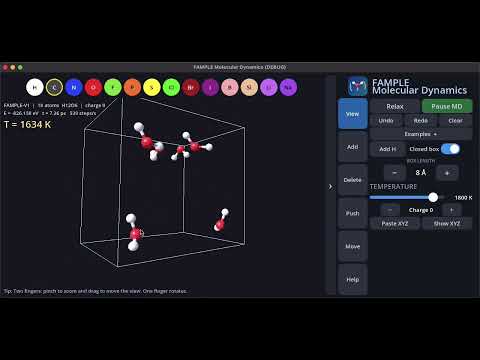
Hydrogen and oxygen molecules collide, their bonds break, and the atoms recombine into water. The simulation shows the rearrangement that the balanced equation hides.
2 H₂ + O₂ → 2 H₂O
Molecular dynamics app
FAMPLE Molecular Dynamics simulates molecular systems and chemical reactions using learning potentials trained on high-level quantum chemistry data.
The app
FAMPLE Molecular Dynamics simulates chemical reactions by computing interatomic forces and propagating atomic trajectories according to Newton’s laws of motion.
By allowing bonds to dynamically form and break during a simulation, FAMPLE goes beyond basic vibrational dynamics to map real reaction mechanisms. Users can observe reactant approaches, bond cleavage, and product formation in real time, making it a powerful tool for teaching chemistry and building physical intuition.
How it works
Place the reactant molecules in the simulation box with their atoms, bonds and starting positions.
At each time step the app evaluates the forces every atom feels from its neighbours.
Positions and velocities are advanced in tiny femtosecond-scale steps, producing a trajectory.
Bonds break and form as atoms collide, and the trajectory is rendered as an animation you can follow.
Videos
Three reactions, each run as a molecular dynamics simulation.
Video 1 of 3
Hydrogen and oxygen molecules collide, their bonds break, and the atoms recombine into water. The simulation shows the rearrangement that the balanced equation hides.
2 H₂ + O₂ → 2 H₂O
Video 2 of 3
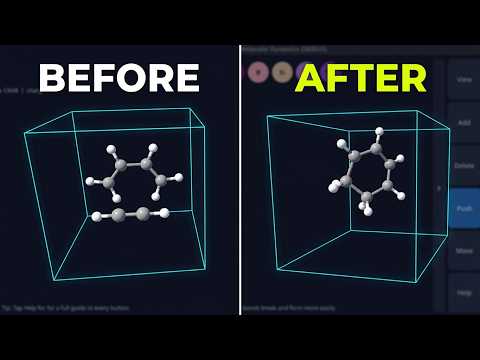
A conjugated diene and a dienophile join in a [4+2] cycloaddition. Two new carbon–carbon sigma bonds form in one concerted step, closing a six-membered ring.
diene + dienophile → cyclohexene ring
Video 3 of 3
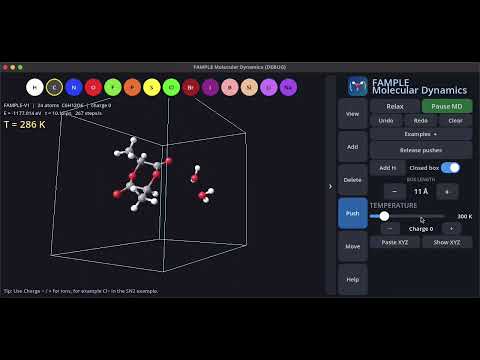
Two lactic acid molecules condense into lactide, a cyclic diester, releasing water. Lactide is the monomer used to make polylactic acid (PLA), a common biodegradable plastic.
2 C₃H₆O₃ → C₆H₈O₄ + 2 H₂O